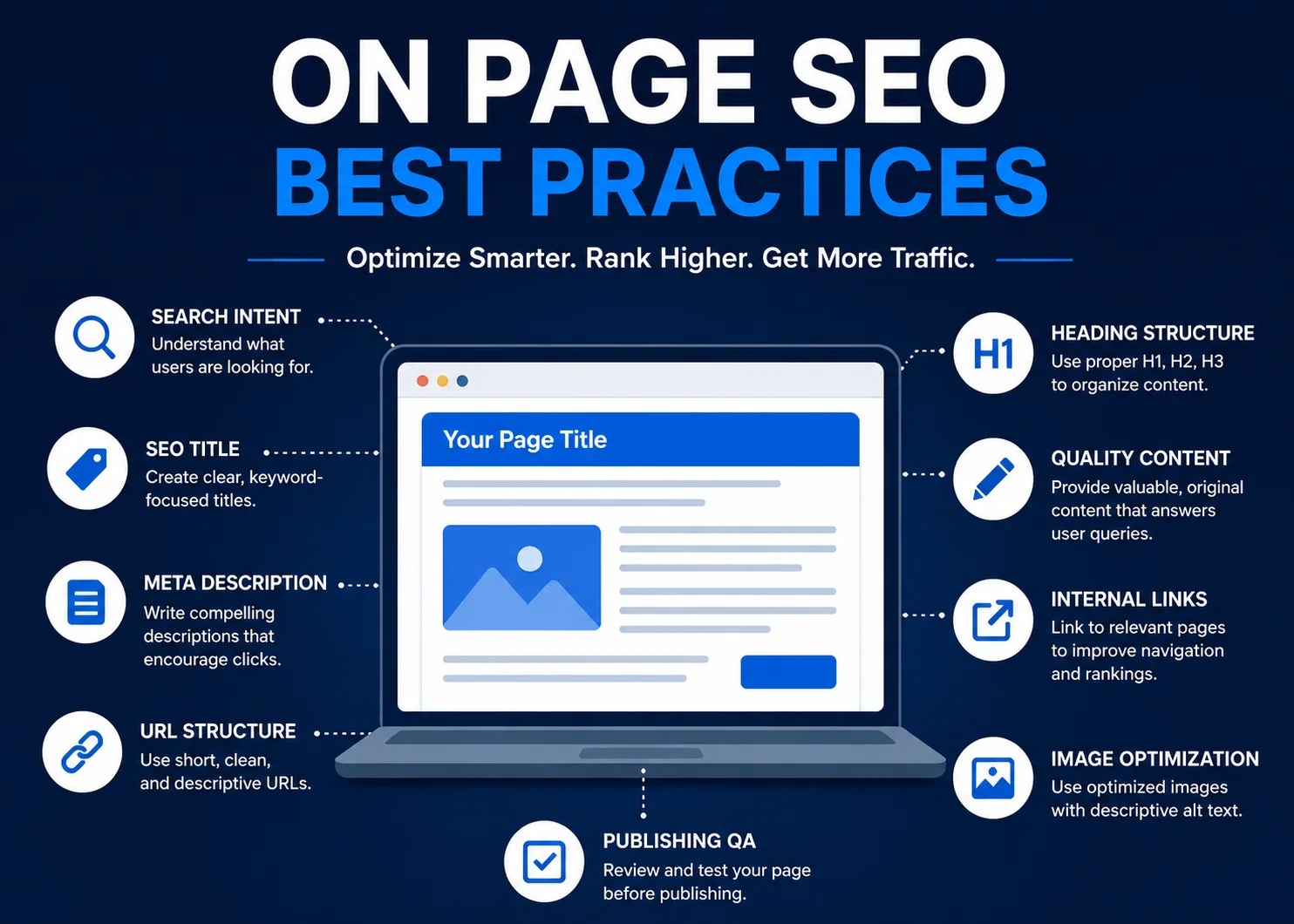
On page SEO best practices help make individual web pages easier for search engines to understand and more useful for the people who visit them. Good on-page optimization is not about repeating a keyword a certain number of times or chasing a perfect plugin score. It is about aligning the page with search intent, structuring the content clearly, optimizing important page elements, and making the final result useful and easy to navigate.
For businesses, marketers, and content teams, on-page SEO also needs to be practical. A recommendation is only useful if it can be implemented correctly on the live page.
This guide covers 12 on-page SEO best practices that can improve how your pages are organized, understood, and presented in search. It also explains common mistakes to avoid and how to build a repeatable optimization workflow.
What Is On-Page SEO?
On-page SEO is the process of optimizing elements on an individual web page to help search engines understand the page and to improve the experience for visitors.
These elements can include:
- Page content
- SEO titles
- Meta descriptions
- URLs
- Heading structure
- Keyword usage
- Internal links
- External references
- Images
- Alt text
- Page readability
- Calls to action
On-page SEO is different from off-page SEO, which focuses more on signals that happen outside your website, such as backlinks and brand mentions.
It is also different from technical SEO, which often deals with broader issues such as crawling, indexing, site architecture, rendering, canonicalization, and technical performance.
There can be overlap between these areas, but on-page SEO is primarily focused on improving the quality and structure of individual pages.
Why On-Page SEO Best Practices Matter
A well-optimized page gives search engines and users clearer signals about what the page is about and why it is useful.
Following good on-page SEO practices can help you:
- Match content more closely to search intent
- Make important topics easier to understand
- Improve page structure and readability
- Create more useful search snippets
- Connect related content through internal links
- Optimize images and other page elements
- Reduce common publishing mistakes
- Keep important pages useful over time
None of these practices guarantees rankings on its own. On-page SEO works best when it supports genuinely useful content and a well-organized website.
12 On Page SEO Best Practices
1. Match Search Intent Before Optimizing Anything
The most important place to start is not the title tag or keyword placement. It is search intent.
Search intent is the reason behind a query. Common intent types include:
- Informational: the user wants to learn something.
- Commercial: the user is comparing options or researching a purchase.
- Transactional: the user is ready to take an action such as buying, booking, or contacting.
- Navigational: the user wants to reach a specific website or page.
If your page does not satisfy the dominant intent behind the keyword, optimizing headings and metadata will not fix the mismatch.
Before writing or optimizing a page, review the search results for the target query. Look at the types of pages that rank, the angle they take, the depth of coverage, and the questions they answer.
For example, if most top results are detailed guides, a thin service page may struggle to satisfy the same intent. If most results are product or service pages, a purely educational article may not be the best fit.
2. Use the Primary Keyword Naturally
Your primary keyword should help define the topic of the page, but it should not control every sentence.
Useful places to include it naturally can include:
- The SEO title
- The page title
- The opening section
- A relevant subheading
- The body copy
- The URL when appropriate
- The meta description
Avoid using the exact phrase repeatedly just to increase keyword frequency.
Modern content usually covers a topic using a mix of:
- Primary keywords
- Close variations
- Related terms
- Relevant entities
- Natural language
The goal is to make the topic clear without making the content sound robotic.
3. Write a Strong SEO Title
The SEO title is one of the most important page elements because it can influence how the page appears in search results and how clearly the topic is communicated.
A useful SEO title should:
- Describe the page accurately
- Include the primary keyword naturally
- Place the keyword near the beginning when it reads well
- Give the searcher a reason to click
- Be unique to the page
- Avoid unnecessary words
For NextWebOps publishing, a practical target is to keep SEO titles at 60 characters or fewer when possible.
A weak title might be:
SEO Guide for Website Pages and Optimization Tips
A stronger title might be:
On Page SEO Best Practices: 12 Tips That Work
The second version is clearer, more specific, and closely aligned with the search query.
4. Write a Useful Meta Description
The meta description gives you space to summarize the page and encourage the searcher to click.
A good meta description should:
- Accurately summarize the content
- Include the focus keyword naturally
- Communicate a clear benefit
- Avoid duplicate descriptions across multiple pages
- Stay concise
For NextWebOps, keep meta descriptions at 160 characters or fewer.
Do not treat the meta description as a place to insert every related keyword. It should read like a useful summary written for a person.
5. Keep URLs Short and Descriptive
A clear URL helps both users and search engines understand the topic of a page.
A good example is:
/on-page-seo-best-practices/
A weaker version might be:
/blog/2026/09/05/complete-best-on-page-seo-practices-guide-tips-123/
In most cases, URLs should:
- Be concise
- Describe the page topic
- Use lowercase letters
- Use hyphens between words
- Avoid unnecessary parameters or filler words
- Include the primary keyword when it fits naturally
Do not change an established URL casually. Changing published URLs can create unnecessary redirect and indexing work if there is no clear benefit.
6. Use a Logical Heading Structure
Headings help organize the content for both readers and search engines.
A typical structure includes:
- One main page title or H1
- H2 headings for major sections
- H3 headings for supporting points
Headings should describe the content that follows them. They should not be selected only because of how large or bold they look in the editor.
For example:
H2: On Page SEO Best Practices
H3: Write a Strong SEO Title
H3: Optimize Your Meta Description
This creates a clear hierarchy and makes long content easier to scan.
7. Create Content That Fully Answers the Query
On-page SEO is not only about optimizing HTML elements. The content itself has to be useful.
Strong content should:
- Answer the main question clearly
- Cover important supporting questions
- Use practical examples
- Avoid unnecessary filler
- Explain concepts at the right depth
- Stay focused on the searcher’s needs
Longer content is not automatically better. A 2,000-word article that repeats itself is less useful than a shorter page that answers the query completely.
Likewise, adding sections simply because competitors have them does not make your page stronger. The better approach is to understand what searchers expect and then create something clearer, more practical, or more complete.
8. Add Relevant Internal Links
Internal links connect related pages on the same website.
They can help:
- Users discover additional information
- Search engines understand relationships between pages
- Distribute attention toward important content
- Reduce isolated pages
- Build stronger topic clusters
Use descriptive anchor text that explains where the link leads.
For example, instead of:
click here
use:
internal linking best practices
For a deeper look at this process, see the NextWebOps guide to internal linking best practices.
Internal links should be relevant. Do not add unrelated links just to increase the total number of links on a page.
9. Optimize Images
Images should support the content without adding unnecessary page weight.
A practical image optimization process includes:
- Resizing images before upload
- Compressing files
- Using an appropriate format
- Using descriptive filenames
- Adding useful alt text where needed
- Checking mobile presentation
Modern formats such as WebP can also help reduce file size in many publishing workflows.
For broader guidance, see the NextWebOps guide to image SEO.
If you are working specifically in WordPress, the WordPress image optimization guide covers resizing, compression, formats, alt text, and publishing workflow in more detail.
10. Improve Readability and Page Structure
A page can be technically optimized and still be difficult to read.
Use formatting that helps visitors move through the content easily.
That may include:
- Short paragraphs
- Clear headings
- Bulleted lists
- Numbered steps
- Tables when they genuinely help
- Bold text for important points
- Useful examples
- Clear calls to action
Do not format content simply to make the page look busy. Good formatting should make information easier to understand.
11. Link to Useful External Sources When Appropriate
External links can strengthen a page when they point readers toward useful primary or authoritative sources.
Good reasons to use an external link include:
- Supporting a factual claim
- Referencing official documentation
- Providing additional technical detail
- Pointing to original research
- Helping the reader verify information
Do not add external links simply because an SEO tool suggests that every page should contain a certain number.
Relevance and usefulness matter more than hitting an arbitrary target.
12. Review and Update Important Pages
On-page SEO should not be treated as a one-time task.
Over time, pages may develop problems such as:
- Outdated information
- Broken external links
- Old screenshots
- Weak internal linking
- Outdated metadata
- Missing references to newer content
- Changes in search intent
Important pages should be reviewed periodically.
When updating an older article, look for opportunities to improve the content itself rather than changing a few words just to alter the publication date.
The NextWebOps guide on how to update old blog posts for SEO covers this process in more detail.
On-Page SEO Practices to Avoid
Some optimization tactics create more problems than they solve.
Keyword Stuffing
Repeating the same keyword unnaturally can make content harder to read.
Use keywords where they help clarify the topic, then write naturally.
Writing for SEO Tools Instead of Readers
SEO plugins can be useful for identifying missing fields or basic optimization issues, but a perfect score is not the goal.
Trying to satisfy every suggestion can lead to:
- Awkward keyword repetition
- Forced headings
- Unnecessary links
- Overly long titles
- Content that sounds mechanical
Use tools as guidance, not as a substitute for editorial judgment.
Forcing the Exact Keyword Into Every Heading
Not every H2 or H3 needs the exact focus keyword.
Use descriptive subheadings that help readers understand the structure of the article.
Creating Long Titles to Fit More Keywords
An SEO title should be clear and useful, not a container for every keyword variation.
Adding Unrelated Internal Links
Internal linking should connect useful related content. Random links can distract readers and weaken the logic of your site structure.
Using Headings Only for Styling
Do not use H2 or H3 tags simply because you want larger text. Headings should represent content hierarchy.
Publishing Thin Content
A page that barely answers the query is unlikely to become more useful because its title tag and meta description are optimized.
Ignoring Search Intent
Intent should guide the entire page. If the searcher wants a tutorial, do not give them a vague sales page.
Optimizing Once and Never Revisiting the Page
Important pages should evolve when information, internal-link opportunities, products, services, or search expectations change.
On-Page SEO Best Practices vs. Technical SEO
On-page SEO and technical SEO support each other, but they solve different types of problems.
On-page SEO commonly includes:
- Content optimization
- SEO titles
- Meta descriptions
- URLs
- Headings
- Internal links
- Image optimization
- Content structure
Technical SEO can include:
- Crawling and indexing
- Site architecture
- Canonical implementation
- Rendering
- Structured technical issues
- Sitewide performance
- Sitemaps and robots directives
A page can have excellent content and still struggle if major technical problems prevent search engines from crawling or indexing it properly.
Likewise, a technically perfect page still needs useful content and clear on-page optimization.
A Practical On-Page SEO Workflow
A repeatable workflow helps teams turn SEO recommendations into consistent publishing standards.
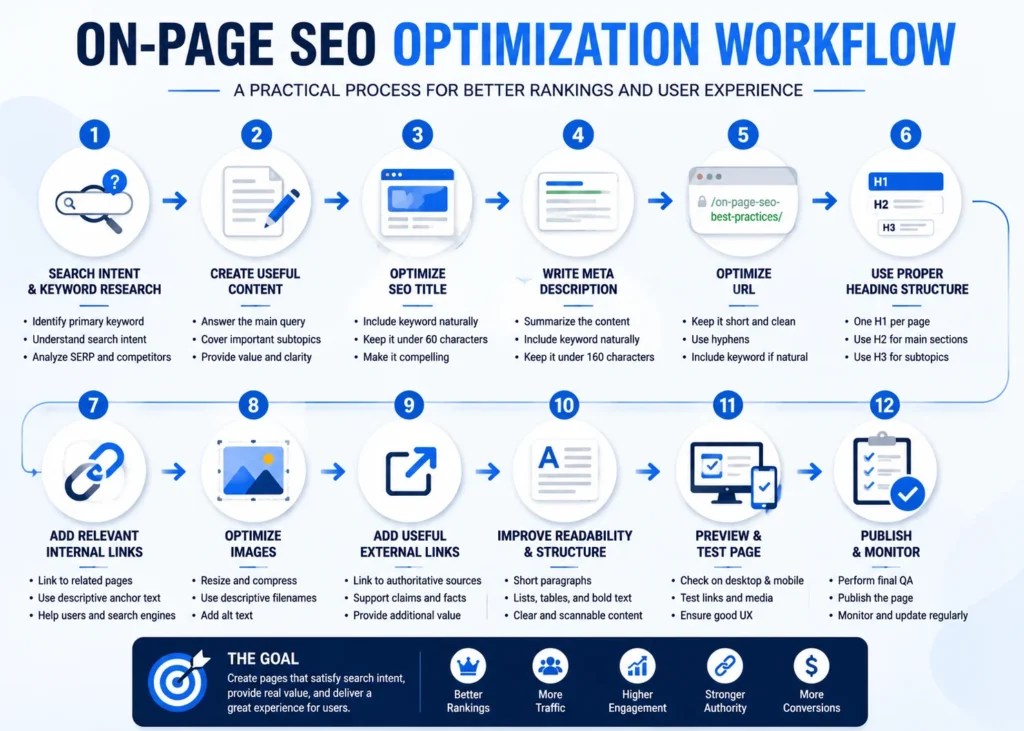
- Confirm the primary keyword and intent. Make sure the topic matches what the searcher expects.
- Review the SERP. Understand common page types, subtopics, and content depth.
- Create useful content. Answer the query clearly and completely.
- Optimize the SEO title. Include the primary keyword naturally and keep it concise.
- Set a clean URL. Use a short, descriptive slug.
- Write the meta description. Summarize the page and communicate a clear benefit.
- Check heading structure. Use logical H2 and H3 hierarchy.
- Add internal links. Connect relevant supporting pages.
- Optimize images. Resize, compress, rename, and add appropriate alt text.
- Add useful external sources. Support claims where necessary.
- Preview the page. Review desktop and mobile presentation.
- Complete publishing QA. Check links, metadata, headings, images, and layout.
- Publish. Make sure the final URL and page settings are correct.
- Monitor and update. Improve important pages as new opportunities appear.
If you prefer a task-based implementation process, use the NextWebOps on-page SEO checklist before publishing.
For existing pages where you need to identify problems first, an on-page SEO audit is the better starting point.
How NextWebOps Supports On-Page SEO Implementation
SEO recommendations create value only when they are implemented correctly on the live website.
NextWebOps supports businesses, agencies, and marketing teams with hands-on content implementation tasks such as:
- SEO title implementation
- Meta description setup
- Heading formatting
- Internal linking
- Image optimization
- Content formatting
- WordPress publishing
- Shopify publishing
- Webflow publishing
- Content updates
- Publishing QA
This can be especially useful when strategists, writers, or SEO teams already know what needs to be done but do not want to spend additional time implementing every recommendation manually.
If your team needs help applying on-page SEO recommendations across WordPress, Shopify, or Webflow, contact NextWebOps to discuss your content implementation workflow.
Frequently Asked Questions About On-Page SEO Best Practices
What are the most important on-page SEO best practices?
The most important practices include matching search intent, creating useful content, optimizing titles and meta descriptions, using clear URLs and headings, adding relevant internal links, optimizing images, and reviewing important pages over time.
Where should keywords be placed for on-page SEO?
The primary keyword can appear naturally in the SEO title, page title, introduction, a relevant subheading, body copy, URL, and meta description. Avoid forcing it into every section or repeating it excessively.
How long should an SEO title be?
A practical target is around 60 characters or fewer when possible. Clarity and relevance matter more than hitting an exact number.
How long should a meta description be?
A practical publishing target is 160 characters or fewer. It should summarize the page accurately and give searchers a reason to click.
Does internal linking help on-page SEO?
Internal links help users discover related content and help search engines understand relationships between pages. Use relevant links and descriptive anchor text rather than adding links randomly.
How often should on-page SEO be updated?
There is no fixed schedule for every page. Review important pages when information changes, rankings decline, search intent shifts, new internal-link opportunities appear, or the page becomes outdated.
Focus on Useful Pages, Not Optimization Tricks
The strongest on page SEO best practices are not complicated tricks. They are a collection of practical decisions that make a page clearer, more useful, and easier to understand.
Start with search intent. Create content that genuinely answers the query. Use descriptive titles, URLs, and headings. Add relevant internal links. Optimize images. Keep the page readable. Then review the final result before publishing.
When those practices become part of a consistent publishing process, on-page SEO becomes less about fixing mistakes after publication and more about producing better pages from the beginning.
Leave a Reply