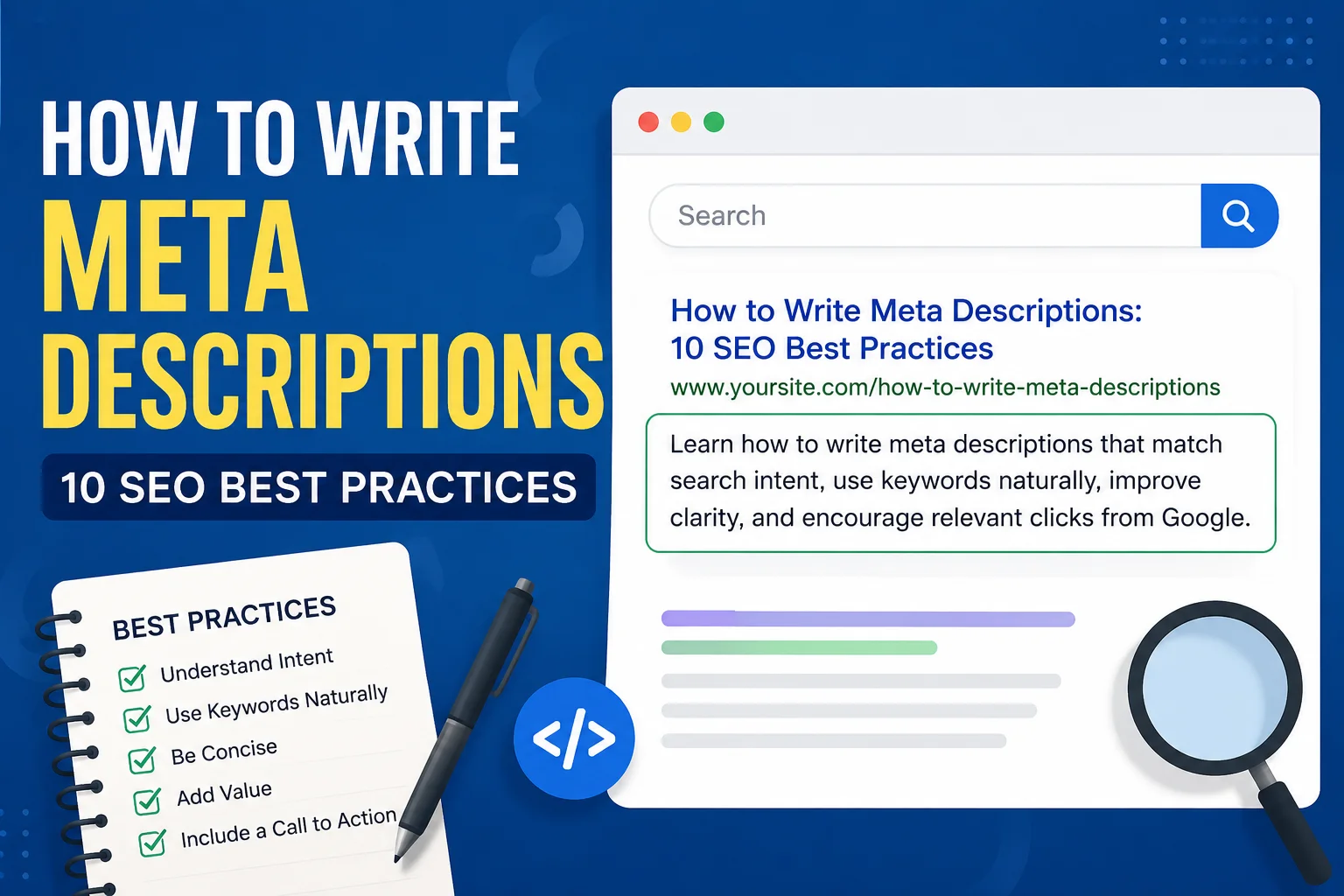
How to write meta descriptions effectively comes down to understanding what a page offers, matching the searcher’s intent, using the main keyword naturally, and giving people a clear reason to choose your result.
A meta description is often one of the first pieces of information a potential visitor sees in Google Search. While Google may sometimes generate a different snippet from your page content, writing a clear and relevant description still gives search engines useful information and helps you control how your page may be presented.
In this guide, you will learn how to write meta descriptions using 10 practical SEO best practices, along with examples, recommended length guidelines, common mistakes, and a simple publishing checklist.
What Is a Meta Description?
A meta description is a short summary associated with a web page. It is added to the HTML <head> section using a meta tag such as:
<meta name="description" content="Learn how to write useful meta descriptions for better search snippets.">
Search engines may use this text as the descriptive snippet shown beneath the SEO title in search results.
A search result commonly includes:
- An SEO title
- The page URL or breadcrumb
- A descriptive search snippet
The meta description helps explain what the page contains and why someone might want to visit it.
However, your submitted description is not guaranteed to appear exactly as written. Google may use other text from the page when it believes that text better matches a particular query.
Why Learning How to Write Meta Descriptions Matters
Understanding how to write meta descriptions is useful because metadata affects how clearly your pages are presented to people searching for information, products, services, or solutions.
Meta descriptions are not a shortcut to higher rankings, but they can make your search result more understandable and more relevant to the searcher’s needs.
They Explain What the Page Offers
A good description gives users a quick preview of the content before they click.
For example, someone searching for an SEO checklist should immediately understand whether the page includes actionable steps or only a general explanation.
They Help Match Search Intent
The wording of a meta description should reflect why someone is searching.
An informational article may use phrases such as “learn,” “understand,” or “use this guide,” while a service page may explain the service and invite a relevant inquiry.
They Support Better Search Presentation
A specific description can help distinguish your page from vague or generic search results.
Meta descriptions should therefore be reviewed as part of a broader on-page SEO checklist, along with titles, headings, content, links, and images.
How to Write Meta Descriptions: 10 Best Practices
1. Understand Search Intent Before Writing
The first step in learning how to write meta descriptions is understanding what the user wants from the page.
Most searches fall into one of several broad intent categories:
- Informational: The searcher wants to learn something.
- Commercial: The searcher is comparing options or researching before making a decision.
- Transactional: The searcher wants to buy, contact, book, download, or complete an action.
- Navigational: The searcher wants a particular website, company, or page.
Your meta description should reflect that intent.
For example, an informational article about image optimization might promise practical tips, while a website publishing service page should explain the service being offered.
2. Accurately Summarize the Page
A meta description should describe what the visitor will actually find after clicking.
Do not advertise:
- A free template that does not exist
- A discount that is unavailable
- A checklist that is not included
- A number of examples the article does not contain
Before writing, ask:
- What is the main purpose of this page?
- What problem does it solve?
- What information or value does it provide?
- What should the visitor expect after clicking?
If your description answers those questions clearly, you are already moving in the right direction.
3. Use the Primary Keyword Naturally
When deciding how to write meta descriptions for SEO, include the primary keyword naturally when it accurately describes the page.
For example:
Learn how to write meta descriptions that match search intent and clearly summarize your page.
This is natural and understandable.
A poor version would be:
How to write meta descriptions SEO meta description writing meta descriptions SEO tips.
Repeating the same phrase does not make the description more useful.
Use your focus keyword once where it fits naturally, then use the remaining space to explain the page’s value.
4. Put Important Information Near the Beginning
Search snippets can appear differently across devices and search queries.
For that reason, avoid putting the main topic or benefit at the very end.
Weak example:
Find useful website information and SEO ideas that may help you, including information about meta descriptions.
Better example:
Learn how to write meta descriptions that match search intent, use keywords naturally, and clearly explain your page.
The second version immediately communicates what the page is about.
5. Write Unique Descriptions for Important Pages
Every important indexable page should ideally have metadata that reflects its individual purpose.
A guide about image SEO should not use the same description as an article about internal linking.
For example, these NextWebOps resources cover different topics:
Each page should have its own description because each page answers a different search need.
Duplicate descriptions can become especially problematic on large websites where the same default metadata is automatically used across many pages.
6. Write for Searchers, Not Only for Rank Math
Rank Math is useful for checking whether your focus keyword appears in important locations and whether your metadata falls within practical limits.
But learning how to write meta descriptions well means going beyond the plugin score.
A description can satisfy every technical check and still sound unnatural.
Over-optimized example:
How to write meta descriptions guide for how to write meta descriptions and meta description SEO.
Better version:
Learn how to write meta descriptions with practical tips for search intent, keywords, clarity, length, and stronger search snippets.
Use Rank Math as guidance, then read the description as a real searcher would.
7. Use Specific and Active Language
Specific wording usually communicates more value than vague descriptions.
Weak:
This page has information about SEO.
Better:
Use this practical SEO checklist to review titles, headings, content, internal links, images, and metadata before publishing.
Useful action-oriented words include:
- Learn
- Review
- Compare
- Discover
- Check
- Improve
- Explore
- Use
The goal is not to make every description sound promotional. It is to make the purpose of the page clear.
8. Add a Call to Action When Appropriate
A call to action can help show searchers what they can do after visiting the page.
Examples include:
- Learn how…
- See practical examples…
- Use this checklist…
- Compare the options…
- Explore the guide…
For commercial pages, calls to action such as “Request a quote” or “Discuss your project” may be appropriate.
Do not force a CTA into every description. Match it to the purpose of the page.
9. Keep Your Meta Description Concise
A common recommendation is to aim for roughly 150 to 160 characters.
That is a useful editorial guideline, but it is not a strict Google requirement.
Google does not guarantee that every description will display to a fixed number of characters. Snippet length can vary, and Google may choose a different portion of the page for certain searches.
The safest approach is to put the important information early and avoid unnecessary filler.
You can review Google’s official guidance on search snippets and meta descriptions for details about how snippets are generated and how meta descriptions may be used.
10. Check the Description Before Publishing
The final step in how to write meta descriptions is quality assurance.
Before publishing, confirm:
- The focus keyword appears naturally
- The description matches the final page
- Spelling and grammar are correct
- The wording is unique
- The SEO title and description work together
- The most important information appears early
- The description is entered in the correct SEO field
- The page preview looks reasonable
A consistent WordPress publishing checklist can help ensure metadata is reviewed before content goes live.
A Simple Formula for How to Write Meta Descriptions
You do not need a complicated formula to create useful metadata.
Try this structure:
Main topic + what the reader gets + key benefit + optional action
Example:
Learn how to write meta descriptions with practical SEO tips for keywords, search intent, length, uniqueness, and better search snippets.
For an image SEO article:
Learn image SEO best practices for filenames, alt text, formats, compression, responsive images, and Google Images visibility.
The formula should guide your writing, not force every page into identical wording.
Good and Bad Meta Description Examples
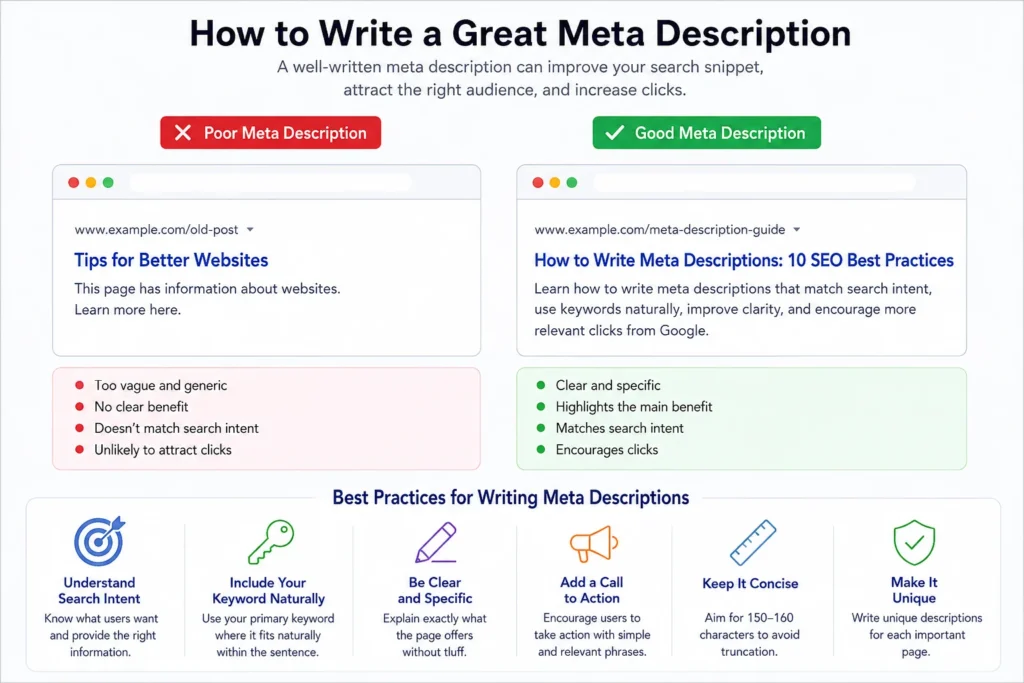
Examples make it easier to understand how to write meta descriptions that are specific instead of generic.
Blog Article Example
Weak:
This article tells you everything about image SEO and images.
Better:
Learn image SEO best practices for filenames, alt text, formats, compression, responsive images, and Google Images visibility.
SEO Checklist Example
Weak:
SEO checklist with tips about SEO.
Better:
Use this practical on-page SEO checklist to review titles, headings, content, links, images, metadata, and other page elements.
Website Publishing Service Example
Weak:
We provide great professional website services.
Better:
Get website content publishing support for formatting, metadata, images, internal links, migrations, and final publishing QA.
The improved descriptions are more useful because they explain exactly what the visitor can expect.
How Long Should a Meta Description Be?
When learning how to write meta descriptions, it is easy to become overly focused on character count.
There is no fixed length that guarantees Google will display every word.
Around 150 to 160 characters is often a practical editorial range because it encourages concise writing and gives enough room to communicate the page topic and benefit.
However:
- Search snippets can vary by query
- Desktop and mobile presentation can differ
- Google may generate a different snippet
- The visible length is not controlled by one fixed character rule
Prioritize clear writing rather than trying to reach exactly 155 or 160 characters.
Why Google May Change Your Meta Description
Even if you know how to write meta descriptions correctly, Google may not always show your submitted version.
Google can generate a snippet from visible page content when it determines that another section better answers the user’s query.
For example, this article discusses:
- How to write meta descriptions
- Meta description length
- Keyword use
- Search intent
- Meta description examples
- Google snippet rewriting
If somebody searches specifically for “meta description length,” Google may select text from the section discussing length rather than display the general meta description.
This is why the page content itself needs to be well structured and relevant in addition to having properly written metadata.
Meta Description vs. SEO Title
| Element | SEO Title | Meta Description |
|---|---|---|
| Main purpose | Identify the primary page topic | Explain the page in more detail |
| Search appearance | Usually the prominent result headline | Usually supporting descriptive text |
| Keyword use | Use the primary topic naturally | Include relevant terms naturally |
| Writing goal | Communicate relevance and topic | Provide context and a reason to visit |
The SEO title and description should complement each other rather than repeat the same sentence.
How to Write Meta Descriptions in WordPress
If you use WordPress with Rank Math, adding the description is straightforward.
- Open the post or page in WordPress.
- Open the Rank Math SEO settings.
- Go to the snippet editor.
- Review the SEO title.
- Enter the meta description.
- Check the preview.
- Confirm the focus keyword appears naturally.
- Publish or update the page.
Do not rely only on the score. Read the final metadata manually and compare it with the actual page.
When performing an on-page SEO audit, review existing meta descriptions for missing text, duplication, outdated information, and weak search intent alignment.
Common Mistakes When Writing Meta Descriptions
Keyword Stuffing
Do not repeat the focus keyword several times simply to increase keyword density.
Using Duplicate Descriptions
Important pages should have descriptions that accurately reflect their individual content.
Writing Only for Character Count
A description is not automatically effective because it contains exactly 155 characters.
Making Unsupported Claims
Do not promise something that the visitor cannot find on the page.
Repeating the SEO Title
Use the description to add context rather than restating the title word for word.
Using Generic Copy
Descriptions such as “Welcome to our website” do little to explain why someone should visit.
Ignoring Metadata When Updating Content
If a page changes substantially, its old description may no longer be accurate.
Include metadata when you update old blog posts for SEO.
Expecting Google to Always Use Your Version
The meta description you submit can influence the snippet, but Google may generate different text for certain queries.
How to Write Meta Descriptions: Final Checklist
Before publishing, use this checklist:
- Does the description accurately summarize the page?
- Does it satisfy the intended search intent?
- Does it use the focus keyword naturally?
- Is the most useful information near the beginning?
- Is it unique for this page?
- Does it communicate a clear benefit?
- Is the wording specific?
- Is it concise?
- Does it complement the SEO title?
- Is it entered correctly in Rank Math or your CMS?
- Have you checked spelling and grammar?
- Does the final page support the promise made in the description?
Make Meta Descriptions Part of Your Publishing Workflow
Knowing how to write meta descriptions is most useful when metadata becomes a standard part of your publishing process.
A complete content implementation workflow should review:
- SEO title
- Meta description
- URL slug
- Heading structure
- Internal links
- External references
- Images and alt text
- Content formatting
- Schema settings
- Desktop and mobile presentation
- Final publishing QA
If the article was created from an SEO strategy, its metadata should also reflect the search intent and positioning defined in the original SEO content brief.
NextWebOps provides hands-on website content implementation, metadata optimization, internal linking, image optimization, formatting, migrations, and publishing QA for WordPress, Shopify, and Webflow websites.
If your content is written but your team needs help implementing and publishing it correctly, contact NextWebOps to discuss your website publishing workflow.
Frequently Asked Questions About How to Write Meta Descriptions
What is a meta description?
A meta description is a short summary associated with a web page that Google and other search engines may use when creating the descriptive text displayed in a search result.
How do you write a good meta description?
To write a good meta description, accurately summarize the page, match search intent, include the primary keyword naturally, communicate the main value early, use specific language, and keep the wording concise.
How long should a meta description be?
There is no strict Google character requirement. Around 150 to 160 characters is a useful editorial range for many pages, but snippet display length varies.
Do meta descriptions help SEO?
Meta descriptions should not be treated as a direct ranking factor. Their primary value is helping communicate relevance and page content to searchers when the description is used in a search snippet.
Should the focus keyword be in the meta description?
Yes, when it naturally describes the page. Include it once where appropriate rather than repeating it unnecessarily.
Why does Google rewrite meta descriptions?
Google can choose page text that it believes better answers a specific search query, so the search snippet may differ from the meta description entered in your CMS.
Should every page have a unique meta description?
Important indexable pages should generally use descriptions that accurately represent their individual content rather than sharing the same generic description.
What is a good meta description example?
For this article, an example is: Learn how to write meta descriptions that match search intent, use keywords naturally, improve clarity, and encourage relevant clicks from Google.
Leave a Reply