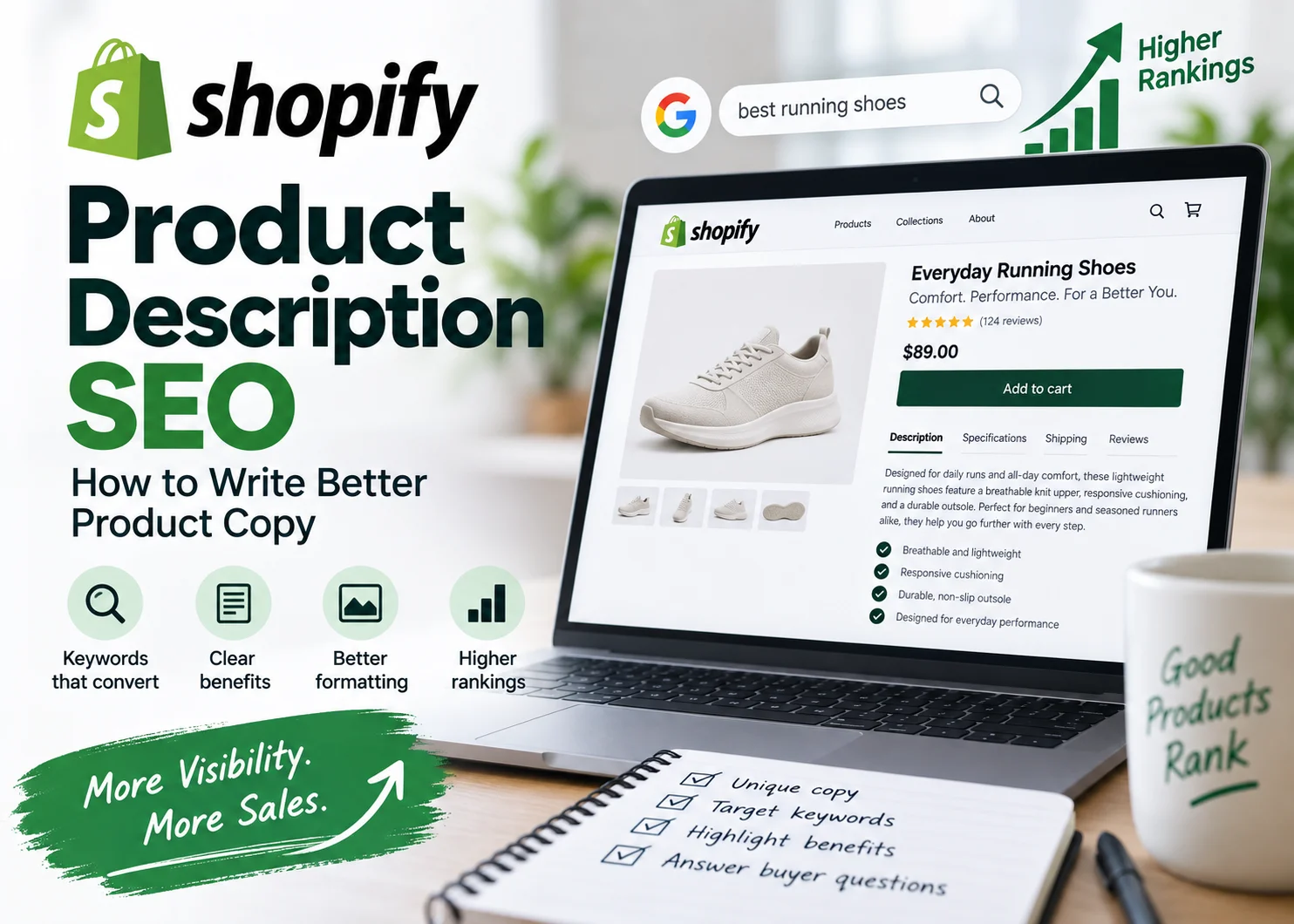
Shopify product description SEO is about writing product copy that helps search engines understand what you sell while giving shoppers the information they need to decide whether a product is right for them.
That sounds simple, but many Shopify stores still rely on copied supplier descriptions, vague marketing language, keyword-heavy paragraphs, or thin product copy that says very little about the actual item.
A stronger product description does three jobs at once: it matches product-level search intent, communicates useful benefits and specifications, and supports the rest of the product page with clear, scannable content.
This guide explains how to write better Shopify product descriptions, how to structure them for search and conversions, how to avoid duplicate content, and how to implement them consistently across a growing catalog.
What Is Shopify Product Description SEO?
Shopify product description SEO is the optimization of the main product copy that appears on an individual product page.
The goal is not to turn every description into an essay. It is to give shoppers and search engines a clear understanding of:
- what the product is
- who it is for
- what makes it useful
- which features matter
- what specifications affect the buying decision
- how the product fits into the rest of your catalog
A product description is only one part of a complete Shopify product page SEO strategy. Titles, metadata, URLs, images, internal links, structured data, reviews, and page usability all contribute to the overall page.
Shopify’s own SEO product description guidance emphasizes writing for shoppers first and using product copy to help search engines understand what the item is and who it is for.
How to Write SEO-Friendly Shopify Product Descriptions
1. Start With the Right Product-Level Keyword
The description should support a keyword that actually fits an individual product page.
Broad category terms often belong on collection pages.
For example:
Too broad for one product:
women's shoes
More appropriate for a specific product:
women's waterproof trail running shoes
The second phrase describes a much more specific product intent.
If a keyword represents a category where shoppers expect multiple options, target it through your Shopify collection page SEO strategy instead of forcing it onto one SKU.
2. Write for Shoppers First
Product descriptions should answer real buying questions before they worry about search engines.
A useful description should make it easy to understand:
- what the product does
- who should buy it
- what problem it solves
- what makes it different
- what details matter before purchase
Compare these two examples.
Weak:
High-quality premium waterproof running shoe made with the best materials for excellent performance.
Better:
Built for wet and technical trails, this waterproof running shoe combines a sealed upper, high-grip outsole, and cushioned midsole to help runners stay comfortable and stable across uneven terrain.
The second version explains the product rather than simply praising it.
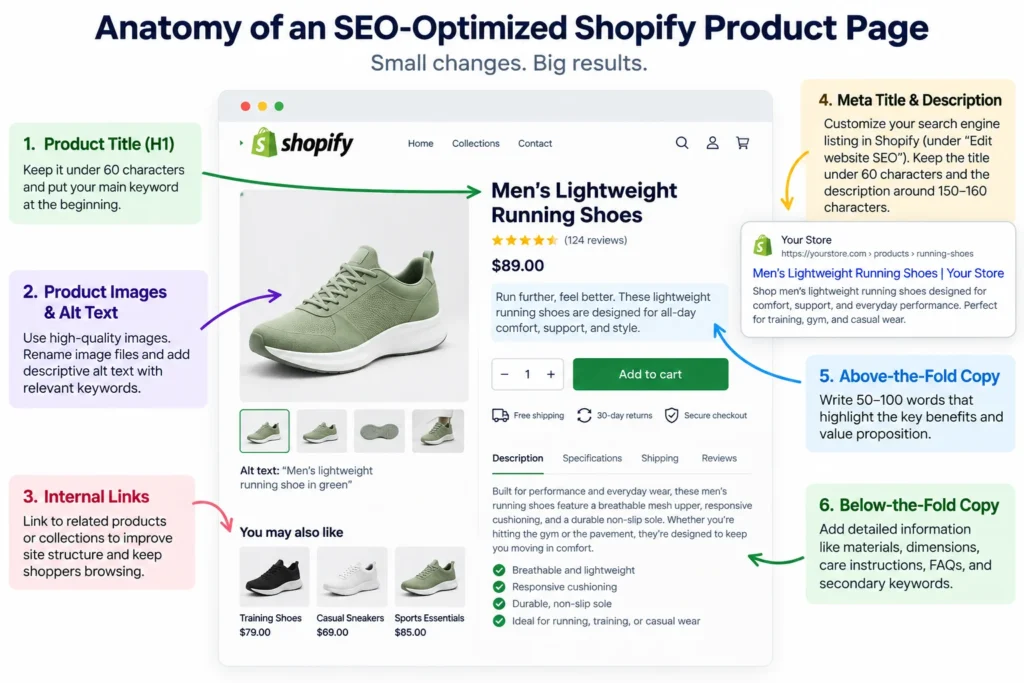
3. Lead With the Main Benefit Above the Fold
The opening section of the product description should quickly communicate the product’s main value.
For many products, that means a short introductory paragraph containing:
- the product type
- the main use case
- the primary benefit
- one meaningful differentiator
You do not need to force a fixed word count into this section. The goal is to give mobile and desktop shoppers useful information without making them scroll through a long introduction before they understand the product.
For example:
The XR200 women’s waterproof trail running shoe is designed for wet, uneven terrain. A breathable waterproof upper helps keep feet dry, while the lugged outsole provides grip on rocky and muddy surfaces.
That opening is specific, useful, and naturally includes relevant product terminology.
4. Turn Features Into Customer Benefits
Specifications matter, but shoppers also need to understand why those specifications are useful.
For example:
Feature:
Waterproof membrane
Benefit-focused version:
Waterproof membrane helps keep feet dry during wet-weather runs.
Another example:
Feature:
600D recycled polyester
Benefit-focused version:
Durable 600D recycled polyester provides everyday abrasion resistance while using recycled material.
Do not remove technical specifications. Explain them in a way that makes their value clear.
5. Add Useful Details Below the Fold
After the opening value proposition, provide the deeper information a shopper may need before purchasing.
Depending on the product, that can include:
- materials
- dimensions
- weight
- sizing
- fit
- compatibility
- care instructions
- warranty information
- included accessories
- technical specifications
For a simple ceramic mug, the description may remain short.
For a technical backpack, laptop dock, running shoe, appliance, or expensive piece of furniture, shoppers may need much more detail.
Useful depth should determine length, not an arbitrary SEO target.
6. Use Keywords and Related Terms Naturally
A good product description usually includes the primary product term naturally because that term accurately describes the item.
Related language may also appear naturally through:
- materials
- use cases
- features
- sizes
- product category
- customer needs
For a waterproof trail running shoe, natural supporting terms might include:
- trail grip
- waterproof upper
- technical terrain
- cushioned midsole
- running outsole
There is no useful reason to repeat the exact primary keyword in every paragraph.
Do not optimize toward a keyword-density percentage. Write clear product copy and make sure important terminology appears where it genuinely belongs.
7. Format Product Descriptions for Easy Scanning
Even strong copy can underperform if it is difficult to read.
Use formatting that helps shoppers scan the page quickly:
- short paragraphs
- clear subheadings
- bullet points
- specification lists
- short labeled sections
A long wall of text is especially difficult on mobile.
For a detailed product, the structure might look like:
Overview
Short benefit-led introduction.
Key Features
- feature + benefit
- feature + benefit
- feature + benefit
Specifications
- material
- dimensions
- weight
Care or Sizing
Additional purchase information.
If you already have product content but need it formatted and implemented consistently across a store, get help with Shopify product content publishing.
8. Write Unique Copy Instead of Reusing Supplier Descriptions
Supplier and manufacturer descriptions are convenient, but they are often reused by many retailers.
Publishing the exact same paragraph as dozens of competing stores gives customers very little reason to prefer your page and limits your opportunity to add useful, brand-specific information.
Instead, improve the copy with:
- clearer benefits
- buyer-specific use cases
- original formatting
- accurate specifications
- real questions customers ask
- details about fit, installation, compatibility, or care
Do not rewrite simply for the sake of making the wording different.
The goal is to make the description more helpful.
9. Add Relevant Internal Links
Product descriptions can sometimes provide useful opportunities for contextual internal links.
Relevant destinations might include:
- the parent collection
- a related collection
- a sizing guide
- a care guide
- a compatibility page
- a relevant educational article
For example, a waterproof hiking boot description could link to a guide explaining how to choose hiking boot sizing if that resource genuinely helps the buyer.
Do not insert links merely to increase link count.
Use your broader Shopify internal linking strategy to connect products, collections, and informational content in both directions.
10. Complete a Final Product Description QA
Product copy should be checked on the live storefront after publishing.
Review:
- factual accuracy
- spelling and grammar
- product variant accuracy
- formatting
- keyword use
- duplicate copy
- internal links
- mobile layout
- spacing
- buttons and expandable sections
Check whether important text has been accidentally hidden behind tabs or collapsed elements and whether the description remains readable on a small screen.
For catalogs with hundreds of products, this QA step matters because one template or publishing mistake can affect many pages at once.
How Long Should a Shopify Product Description Be?
There is no universal ideal product description length.
The SERP for this topic often includes recommendations such as 300 to 500 words, but that should not become a rule for every product.
A simple item may only require a concise paragraph and a few specifications.
A more complex product may need significantly more content to cover:
- features
- benefits
- dimensions
- compatibility
- sizing
- technical details
- care
- installation
Adding 400 words of filler to a simple product does not make the page better optimized.
The better question is:
Does the description give the customer enough information to understand and evaluate the product?
Shopify Product Description SEO Example
Consider a fictional product:
XR200 Women’s Waterproof Trail Running Shoe
Weak Product Description
High-quality waterproof trail running shoe. Comfortable and durable. Great for running and hiking. Buy now.
This description is short, but the main problem is not its length.
It is vague.
It does not explain the terrain, fit, materials, grip, cushioning, waterproofing system, or intended user.
Better Product Description
The XR200 women’s waterproof trail running shoe is built for runners who need reliable grip and weather protection on wet, uneven trails. Its breathable waterproof upper helps keep moisture out while allowing heat to escape, and the lugged rubber outsole provides traction on mud, gravel, and rocky surfaces.
Key benefits:
- Waterproof upper helps keep feet dry in wet conditions.
- Deep outsole lugs improve traction on loose and technical terrain.
- Cushioned midsole helps absorb impact over longer trail runs.
- Reinforced toe provides additional protection from rocks and debris.
Specifications:
- Upper: breathable waterproof synthetic mesh
- Outsole: high-grip rubber
- Midsole: cushioned EVA foam
- Use: trail running and light hiking
- Fit: standard women’s fit
Need another option? Explore the women’s trail running shoes collection for additional styles and terrain types.
The improved version gives search engines more product context because it gives the shopper more useful product information.
Shopify Product Description SEO Template
Use this framework as a starting point for new Shopify product descriptions.
Product Name
[Product or model name] + [useful product type or differentiator]
Opening Value Proposition
Write one short paragraph that explains:
- what the product is
- who it is for
- the main use case
- the main benefit
Key Benefits
- Benefit one
- Benefit two
- Benefit three
Features
- Feature + why it matters
- Feature + why it matters
- Feature + why it matters
Specifications
- Material
- Dimensions
- Weight
- Compatibility
- Included items
Additional Information
Add only what applies:
- sizing
- care
- warranty
- installation
- shipping considerations
- compatibility guidance
Internal Links
Add links only when useful, such as:
- parent collection
- related category
- size guide
- care guide
Product Description vs Meta Description
These are different fields with different jobs.
Product Description
The product description appears on the product page and can contain detailed information about the item.
It helps:
- explain the product
- answer buying questions
- support search relevance
- improve conversion
Meta Description
The meta description is a short summary used as an input for search-result snippets.
Shopify’s SEO keyword and metadata guidance explains how merchants can edit page titles and meta descriptions within Shopify.
The meta description should summarize the page concisely rather than duplicate the entire product description.
For example:
Product description:
Detailed content about waterproofing, grip, cushioning, sizing, materials, and use.
Meta description:
Shop XR200 women’s waterproof trail running shoes with high-grip outsoles, cushioned midsoles, and weather-ready comfort for wet trails.
Product Description vs Product Title
The product title identifies the item.
The description explains it.
A title might be:
XR200 Women’s Waterproof Trail Running Shoes
The description then expands on:
- terrain
- weather protection
- grip
- comfort
- fit
- materials
Do not try to squeeze every feature and search term into the title.
Common Shopify Product Description SEO Mistakes
- Copying supplier descriptions: Reused manufacturer copy adds little differentiation.
- Using vague marketing language: Claims such as “premium quality” mean little without specifics.
- Keyword stuffing: Repeating product terms unnaturally hurts readability.
- Listing features without benefits: Explain why features matter.
- Ignoring buyer-specific details: Include sizing, compatibility, care, or dimensions when relevant.
- Using identical copy across variants: Distinguish meaningful differences where the products genuinely differ.
- Publishing long walls of text: Use headings, paragraphs, and lists.
- Adding no relevant internal links: Useful supporting pages can improve navigation.
- Forcing a fixed word count: Product complexity should determine content depth.
- Skipping mobile QA: Always inspect the live product page on smaller screens.
- Confusing product descriptions with meta descriptions: They serve different purposes.
Shopify Product Description SEO Checklist
- Choose a product-level keyword that matches search intent.
- Write original product copy.
- Lead with the primary customer benefit.
- Explain important features.
- Add relevant specifications.
- Use keywords naturally.
- Format the copy for easy scanning.
- Add internal links where useful.
- Verify all product facts.
- Review mobile presentation.
- Check the live storefront after publishing.
Need help reviewing descriptions, metadata, links, formatting, and catalog consistency? Discuss your Shopify product publishing workflow with NextWebOps.
How Product Descriptions Fit Into Shopify Product Page SEO
A strong product description cannot compensate for a weak product page by itself.
Product copy should work together with:
- the product title
- SEO title and meta description
- clean URL structure
- product images
- image alt text
- internal links
- structured data
- reviews
- mobile usability
- page speed
For product imagery specifically, use accurate, descriptive Shopify image alt text rather than treating alt fields as keyword lists.
When all of these elements work together, the page becomes easier for search engines to interpret and easier for shoppers to evaluate.
Final Thoughts on Shopify Product Description SEO
Good Shopify product descriptions are not written for algorithms first.
They are written to help shoppers understand the product, compare it with alternatives, and make a confident decision.
The SEO value comes from accurate product language, useful detail, clear structure, original copy, natural keyword use, and strong connections to the rest of the store.
For small catalogs, that can be handled product by product. For stores with hundreds or thousands of SKUs, product descriptions become a content operations challenge involving templates, formatting, consistency, internal linking, metadata, and QA.
NextWebOps helps ecommerce businesses and agencies implement Shopify product descriptions, metadata, images, internal links, formatting, and publishing QA across growing catalogs.
Contact NextWebOps about your Shopify product content.
Frequently Asked Questions
How long should a Shopify product description be?
There is no fixed ideal length. Simple products may need only concise copy and a few specifications, while complex or expensive products may require significantly more detail. Write enough to answer important buyer questions without adding filler for SEO.
Do Shopify product descriptions help SEO?
Yes. Product descriptions provide search engines with useful context about what the product is, what features it has, and which searches it may be relevant to. Their main purpose should still be helping shoppers understand the product.
How do I write an SEO-friendly Shopify product description?
Choose the right product-level search intent, write original shopper-focused copy, explain benefits and specifications, use relevant terminology naturally, format the page clearly, and complete a live-page QA check after publishing.
Should every Shopify product have a unique description?
Important products should have content that accurately reflects their own features and use cases. Similar products may naturally share some terminology, but copying the exact same description across many different SKUs can make the catalog less useful.
Can I use manufacturer descriptions on Shopify?
You can use accurate manufacturer information as a source, but publishing the exact supplier copy often misses opportunities to add buyer-specific benefits, use cases, formatting, internal links, and your own brand context.
How many keywords should I use in a product description?
There is no ideal keyword count. Use the main product term and relevant supporting language where they naturally describe the product. Avoid repeating phrases solely to increase frequency.
What is the difference between a product description and a meta description?
The product description appears on the actual product page and can provide detailed information. The meta description is a short summary intended for search-result snippets and should concisely describe the page.
Should Shopify product descriptions include internal links?
They can when the links genuinely help the shopper. Useful destinations might include a parent collection, sizing guide, care guide, compatible product, or related educational resource.
What should I include in a Shopify product description?
Include the product’s main benefit, important features, specifications, materials, use cases, sizing or compatibility information, care instructions, and other details that help the customer evaluate the item.
Can AI write Shopify product descriptions?
AI can help generate drafts and speed up large catalog workflows, but the output should be reviewed for factual accuracy, repetitive language, unsupported claims, incorrect specifications, keyword stuffing, and brand consistency before publishing.
Leave a Reply